


As a network, we’re so often the entry point for brands to the affiliate channel. The process often starts as a conversation between brand-side (advertiser) digital marketing managers and our team.
You’ve correctly identified affiliate partnerships as an effective way to achieve your main objectives of growing ecommerce website traffic and sales whilst increasing ROAS and ROI, and now need to convince senior stakeholder decision-makers to sign it off.
Before doing that, it’s wise to consider the common objection you’ll face in this scenario. Generally, this is based around a misconception that like: ‘affiliate marketing is basically a voucher-site channel that picks up conversions at the end of the customer journey. It’s useful for closing sales, but it’s not really a meaningful growth driver’.
Our response to this objection is twofold. Firstly, voucher publisher investment is actually declining across the affiliate landscape, with spend down 7% year-on-year according to The APMA. Secondly, stakeholders responsible for budget decisions will always expect recommendations to be commercially viable, low risk, measurable, and capable of addressing genuine business challenges. Positioning affiliate marketing in this way shifts the conversation from simply closing sales to demonstrating its value as a strategic growth channel.
First and most importantly – the commercial strength of affiliate marketing is now undeniable. For instance, the UK membership body for the channel – The Affiliate & Partner Marketing Association – just published their latest State of the Affiliate Nation report highlighting that in 2025:
- UK brands made £15 for every £1 they spent on affiliate marketing
- Publishers generated £21 billion for their UK brand and retail partners
- The affiliate industry grew 5x faster than the UK economy overall
These are some really big and impressive headline numbers – perfect to include in the executive summary of your business case, but not quite enough alone! Diving slightly deeper, we’ve put together a list of the top eight things every C-Suite needs to hear so that they simply can’t say no to your growth journey with affiliate marketing.
In no particular order, here’s what you should tell your C-Suite…
Tell them: ’We’ll only pay for results’
If you had to justify one channel to your leadership team right now, it’d need to be accountable, scalable, and most importantly, tied to your revenue. Affiliate marketing’s performance-based commission structure allows your business to grow without the same upfront costs you’ve grown to expect from other channels (see PPC!).
This immediately starts to change how your marketing budget can work for you. Instead of investing money heavily on a possibility of a sale, every pound spent on affiliate marketing can be directly tied to revenue. We’re confident that you’ll start seeing a reduction in wasted spend on impressions or ads that fall on deaf ears. This marketing model also shifts the risk away from you as the brand. If the campaign doesn’t perform, you don’t pay – making it one of the more efficient and low-risk ways to drive growth.
Tell them: ‘We could make ‘X’ in additional sales’
Let’s be honest, there’s loads of great things about affiliate marketing – from the fact that it’s performance-based to the advantage of offering full funnel marketing. However, perhaps the best thing you can possibly tell your decision makers is how much growth it can generate for your brand in both website traffic and revenue. That’s why we built the Webgains Affiliate Calculator. To use it, and get your affiliate uplift, simply plug in your average monthly website traffic, main vertical, and your AOV to get your results immediately.
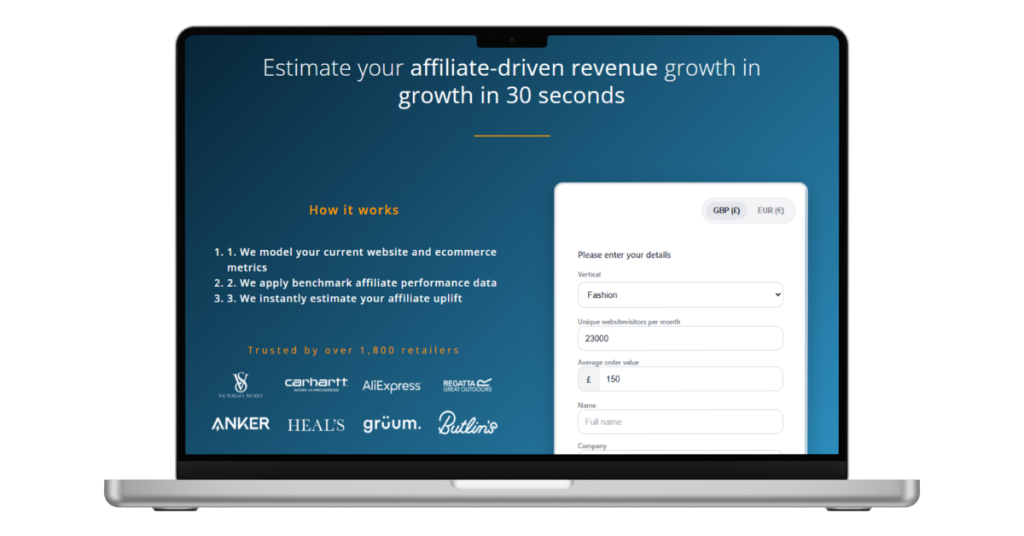
Using a formula encompassing our vast network performance data and established conversion rates by vertical, here’s an example of the projected growth for a fashion brand with 50,000 UWVs and an AOV of £85:
+ 90,000 website traffic over 12 months
+ £1,071,000 revenue over 12 months
What are you waiting for? Give it a go for yourself right here.
Tell them: ‘It’s a genuine full funnel strategy tied up in one channel’
Working with affiliate partners gets your brand noticed everywhere. If you sign up with a network like Webgains, you get access to experts who build a full-funnel strategy around your brand; these don’t have to be isolated campaigns, as you’re tapping into an entire ecosystem built to influence every stage of the buying journey.
At the top of the funnel, you can boost your visibility through performance PR partners like Linkby, who place your business in high-quality editorial environments to drive awareness and consideration. As your users move closer to purchase, you can introduce conversion-led tactics, and add relevant onsite incentives at checkout through partners like Tyviso. They integrate directly into your basket to offer value-driven rewards, without relying on discounting.
Closed group partners can add another layer of influence at the lower end of your funnel, where trust and relevance matter most. These communities offer advantages that Google and social media algorithms can’t always compete with, as they’re built around shared identities and interests. Blue Light Card is a great example, reaching emergency service workers, NHS staff, and the teaching community, a highly engaged audience with strong purchase intent and a higher likelihood of converting if they see products that are relevant to them.
You’ll soon see that when each stage of the journey is working harder, scaling ecommerce becomes less about increasing spend, and more about applying the right strategy at the right moment. More than 80% of brands use affiliate marketing to drive leads or sales. If this is surprising to you, and you’re part of that 20% – you better move.
Tell them: ‘It’s genuinely scalable’
One of the biggest advantages affiliate gives you is speed. Not only in launching campaigns, but in learning what really works. Once you’ve joined a network, you can tap into different partners, placements, and incentives without the same upfront risk and expenditure you’d have in channels where attribution is unclear or indirect. You can also learn quite quickly what it is that works for your brand, backed by the vast quantity of performance data you’ll have at your fingertips thanks to your network.
This test and learn strategy allows you to optimise when there’s a need for it or add incremental budget during peak periods. Refining your approach flexibly is the true key to a successful affiliate partnership; not waiting for a campaign to go stagnant or the performance to plateau. The faster you learn, the faster you scale – and affiliate is built for exactly that. Take a look at some of our affiliate marketing checklists to see where your program might stand.
For more information about how advertisers are using Smart Commissions to easily control and flex their commission rates during peak periods, read our Knowledge Hub article here.
Tell them: ‘We’ll obtain invaluable data to inform our entire strategy’
Shout it louder for the people in the back: the learnings you get from affiliate marketing can inform your wider strategy. The data you get to tap into is invaluable and provides a clear picture of which partners, audiences and tactics are driving revenue, removing the guesswork from you marketing decisions.
And it’s not just your own performance data. The affiliate channel is one of the most measurable in digital marketing, with industry-wide benchmarks helping brands understand the width and breadth of the opportunity. APMA’s State of Affiliate Nation report uncovers astonishing data around the UK industry’s position of strength, with 357 million sales driven through the channel in 2025 – that’s 41,000 every hour – now that’s a pie your C-Suite are definitely going to want a slice of!
For anyone building a business case internally, this is the kind of data that makes the conversation easier. With a network like Webgains, you can draw on data-rich results to make smarter decisions, pivot faster, and unlock the full revenue potential of the channel.
Tell them: ‘We’ll move beyond ads, and build ourselves a safety-net’
We’re often seeing brands fall into the same trap of relying too heavily on Google and social to do all of your marketing heavy lifting. It works, until it doesn’t, and that’s usually when costs start creeping up and returns become harder to maintain.
Building a contingency plan of diverse channels should hit that sweet spot. Reduce your reliance on those primary growth drivers and start layering in channels that give you more balance and flexibility. This resilient mix is key to growing your brand sustainably by scaling revenue without scaling spend at the same rate. As you test and evolve your strategy and try different partners, you can shift your budget into the channels that prove their value, avoiding the sinkhole of diminishing returns from saturated channels. For leadership teams focused on efficiency, this shift away from spend-dependent growth is becoming increasingly important.
Tell them: ‘Our competitors are already using it’
81% of brands already have an affiliate program. That means that if yours doesn’t, your competitors likely do and are stealing a march on you. With our extensive network data gleaned from millions of transactions tracked by our technology plus retail and commerce experience in our ranks, we produce regular competitor benchmark and analysis reports for our clients. We help brands find and manage partnerships and execute strategies not only to get results but also to efficiently increase market share and outmanoeuvre competing retailers. It’s just like Arsenal and England footballer Declan Rice notoriously said during The Gunners’ 2026 Premier League Trophy parade: ‘Lock in, or get locked out’. Well said, Declan!
Want a bespoke report of your top competitors affiliate marketing activity? Get in touch and tell us who they are and our team will happily take a look. Email hello@webgains.com to make a request.
Tell them: ‘We can gain AI search visibility’
AI Overviews and LLM-driven discovery are steamrolling the way we view and use search. While the format is evolving, the fundamentals still matter and everyone can agree that ranking and visibility within these new search tools are as valuable as ever. One of the most effective ways of boosting visibility? Backlinks from trusted, reputable sources. High quality content placements from partners and publishers will strengthen your authority and increase your chances of getting cited in AI Overviews and Chat GPT/Gemini/Claude answers. Over time, this positions your brand as a credible player in your space, not just another name on page 3 of Google. And as visibility becomes harder to buy outright, this is a strong case for investing in channels that build it organically over time.
Scaling ecommerce today isn’t about chasing marginal gains from the same channels. It’s about finding smarter, more accountable ways to grow, and being able to justify them internally. That’s exactly where affiliate marketing earns its place. It brings together performance, flexibility, data, and scale in a way few channels can match, giving marketers a stronger case for investment and a clearer route to revenue growth. For ecommerce teams under pressure to drive sales, improve efficiency, and think beyond the next paid media spike, look no further than affiliate marketing.
If you need support with your affiliate marketing business case or you have your sign off and are ready to get started, we’d love to hear from you. Please click here and complete our Start a Program webform, contact us, or email hello@webgains.com.